
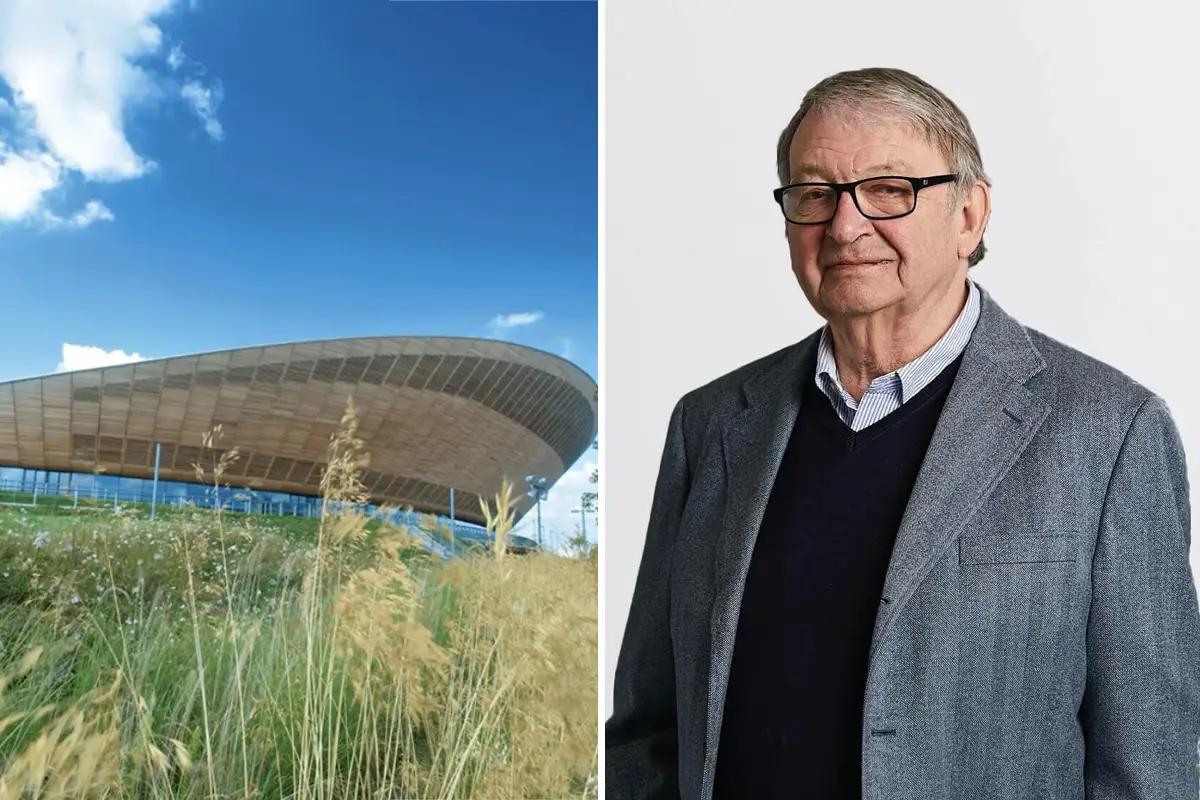
The renowned architect behind the infamous 2012 Velodrome, Sir Michael Hopkins, passed away at age 88 leaving a thriving legacy of creativity and modernity.
Hopkins is most well-known for his works throughout the United Kingdom – having been the mastermind behind the likes of the Glyndebourne Opera House, Westminster Underground Station, and the Olympic Velodrome. Whilst he made an impact on his home turf, Hopkins also worked internationally to create structures within the United States, Tokyo, India, and Dubai.
Michael studied architecture at the Bournemouth School of Art following his mother’s push towards the profession, and it was here that he homed in on what he wanted to achieve. His career began to blossom in the late 1950s upon joining the Architectural Association, and at just 23-years-old, Hopkins was filled with passion for his craft and ready to take on a new challenge.
During his time at the Architectural Association, Michael became closer to fellow student Patricia Wainwright throughout their studies – and this led to a wonderful relationship forming between the two of them. Patricia went on to become Michael’s wife in 1962, but also his working partner, so all aspects of their lives were able to intertwine through their marriage. They eventually went on to set up Hopkins Architects in 1976, where they grew a team to reimagine modern architecture.
Further into his career, Michael was awarded the Royal Institute of British Architects Royal Gold Medal in 1994 for his contributions to British architecture.
In 2009, Hopkins Architects were given the task of designing the velodrome that would go on to be used in the London 2012 Olympic Games. Lee Valley Velopark is one of four permanent structures that makes up the Queen Elizabeth Olympic Park in London, and Hopkins was at the forefront of creation ahead of the historic event.
The venue has a 6,000-seat capacity surrounding the cycling track, with various conference and meeting rooms located around the building. Now, the velodrome has expanded its horizons into the world of education and is the home of the University Campus of Esports – providing academic insight into the world of competitive gaming whilst celebrating the history behind the iconic building.
To learn more about Sir Michael Hopkins and his works, click here.